Northern Honey Fungus (Armillaria borealis)
Armillaria borealis
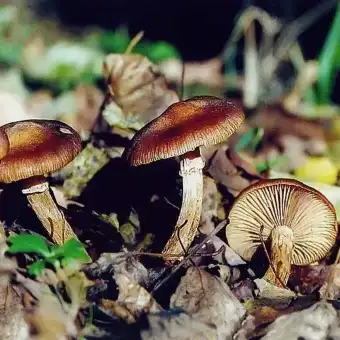
Forests, parks, gardens, roadsides, on deciduous and coniferous wood. Autumn, summer (rarely).
Fruiting bodies medium-sized. Cap 3-8 cm across or larger, with a blunt umbo, irregularly flattened, fibrous and finely scaly in the central part, the margins smooth, grooved, from greyish-yellowish to brown. Young gills white, later cream, ochre-brownish, yellowish-brownish, adnate; when young covered with a membrane of the white veil. Stem 3-8 (10)x0.5-1.5 (2) cm, thickening towards the base, with a white ring, white, yellowish in the upper part, turning brown towards the base, with whitish fibrils. Flesh white, not thick, with a pleasant smell and taste. Characteristic features: cap more shaggy in the middle, stem white in the upper part, with a white ring. Similar to the Honey Fungus, which is currently divided into 3 species. Grows in forests and parks as a parasite and saprotroph, in large groups. Edible.