Anemone Cup
Dumontinia tuberosa
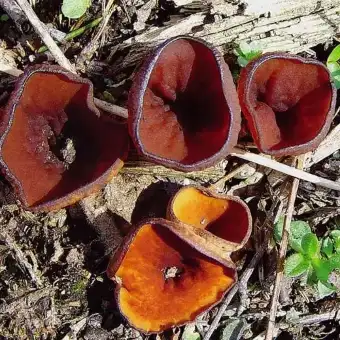
Deciduous and mixed forests. Spring (March-May).
Fruiting bodies small, long-stemmed, several growing from one sclerotium, round and closed when young, later the cap and stem develop. Cap 1–3 cm across, bowl-shaped or shaped like a wide goblet, with the margin curled up or turned out, lobed; the inside smooth, sometimes coarsely wrinkled, dark brown, yellowish-brown, the outer side ochre-yellow, pale brownish. Stem 2-8 (10) cm long and 2-3 (3) cm thick, hollow, curved, brown, thickened near the cap, of even thickness below, black in the lower part, brown felty-hairy down to the sclerotium. Flesh thin, of waxy consistency, odourless, slightly acrid-tasting. Grows from a sclerotium formed on the roots of wood anemones (Anemone), in damp, humus-rich soil. Very similar to the Pixie Cup, which appears only on bonfire sites. Inedible.