Copper Brittlegill
Russula decolorans
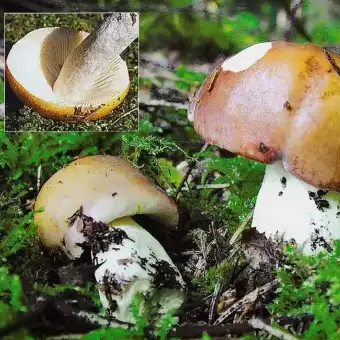
Coniferous forests, especially pine forests. Summer, autumn.
Fruiting bodies large. Cap 5—12 cm across and larger, domed, when old convex-flattened, the centre slightly depressed, margins lobed and grooved; the cuticle peels to the middle; slimy in damp weather, shiny when dry, yellowish-brown, orange-red, fading to brownish. Gills yellowish-white, when old yellow, greyish-blackish. Stem 5-10x1-2.5 cm, white, when old blackish. Flesh white, firm, thick, honey-like in taste, without a particular smell, blackening. Characteristic features: cap from yellowish-brownish to orange-red, fading; gills and stem turn grey and black with age. Grows in groups, sometimes large ones. A very good edible mushroom. Common. An important enzyme, russulin, has been isolated from this brittlegill; it is suitable for making enzyme-ripened cheeses and fully replaces rennin obtained from young lambs and calves.